Particle (Basic ㊦ 135)
A particle which indicates an extent or a degree to which someone/something does something or is in some state.
Equivalent: To the extent of; to the extent that ~; (not as) ~ as ~; about
| (i) Noun | ほど | |
| 君ほど | As you | |
| (ii) Demonstrative | ほど | |
| それほど | To that extent | |
| (iii) Sinformal | ほど | |
| 家が倒れるほど | To the extent that houses would fall down |
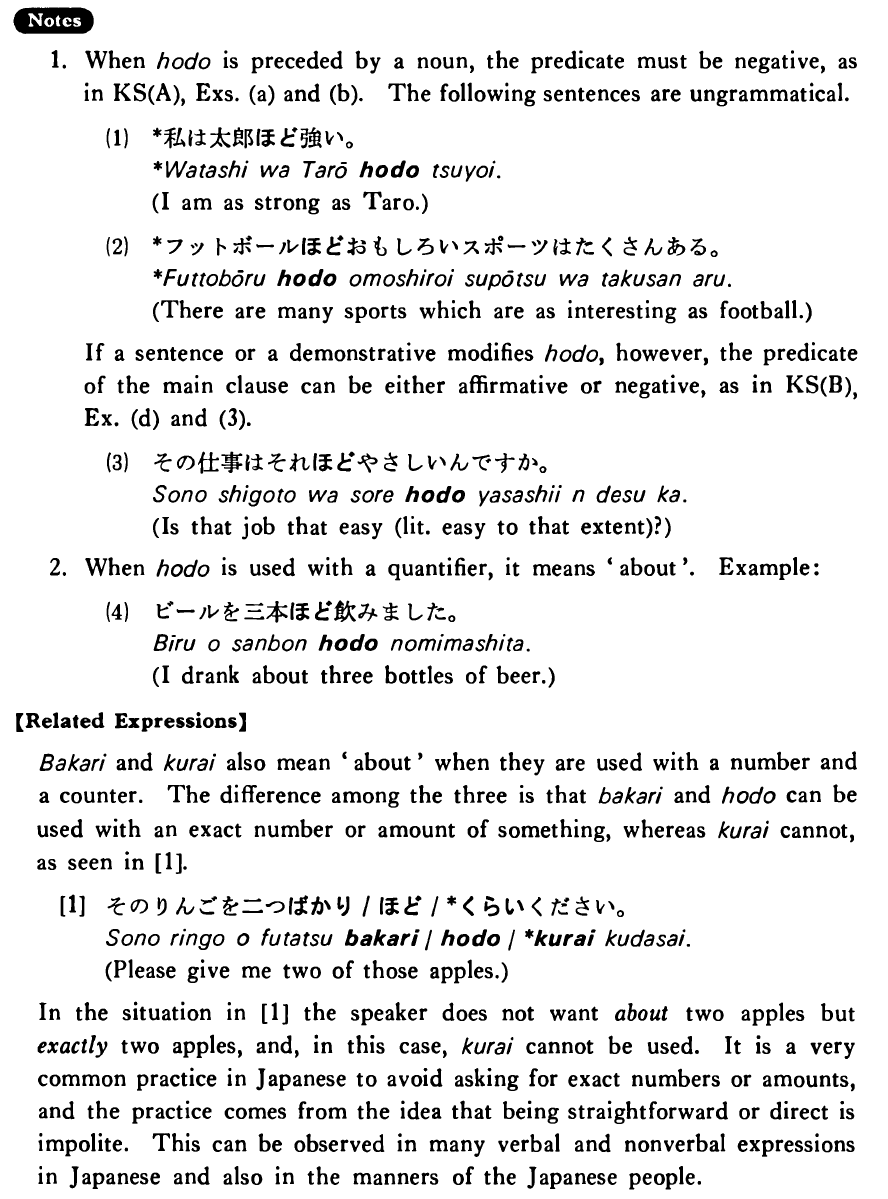
1. When ほど is preceded by a noun, the predicate must be negative, as in Key Sentence (A), Examples (a) and (b). The following sentences are ungrammatical.
If a sentence or a demonstrative modifies ほど, however, the predicate of the main clause can be either affirmative or negative, as in Key Sentence (B), Example (d) and (3).
2. When ほど is used with a quantifier, it means 'about'. Example:
【Related Expressions】
ばかり and くらい also mean 'about' when they are used with a number and a counter. The difference among the three is that ばかり and ほど can be used with an exact number or amount of something, whereas くらい cannot, as seen in [1].
[1]
In the situation in [1] the speaker does not want about two apples but exactly two apples, and, in this case, くらい cannot be used. It is a very common practice in Japanese to avoid asking for exact numbers or amounts, and the practice comes from the idea that being straightforward or direct is impolite. This can be observed in many verbal and nonverbal expressions in Japanese and also in the manners of the Japanese people.